
In Conversation with Jasmine Sun
As part of Interact 2026 Admissions, we’re interviewing members of the Interact community so applicants can get a sense of who we are. Charles Yang, on this year’s admissions committee, caught up with Jasmine Sun.
Jasmine Sun is an independent writer covering the “anthropology of tech” — reporting on the culture of Silicon Valley through reported features, essays, and interviews. She’s the cofounder and director of Reboot, a nonprofit publication by and for technologists, and its annual print magazine Kernel. Before going independent, she was a product manager at Substack. Her work has been published in New York Times, Wall Street Journal, SF Standard, and NPR.
Jasmine, thanks for joining us! We’re honored to have Interact’s “Substacker-in-Residence” with us. Your writing needs no introduction at this point, but I’d love to hear the origin story. Did you have a first piece of writing that you were proud of?
I feel like almost all my past writing is crap—and the earlier you go, the worse it gets.
But I honestly just got lucky with early validation. Like when a kid is really good at tennis or chess—if everyone tells you you’re good at it, you just keep going. I also loved to read, so I wrote because I was reading. I think I’ve been writing for fun since I could write at all.
Do you remember PBS’s Reading Rainbow? They had this program where kids could write a picture book and submit it, and if the producers thought it was good, they’d bring you on TV to read it aloud. Doing that was probably the first hit of validation. Then in elementary and middle school, I spent half my weekends at this nonprofit that ran free writing workshops for teens, taught by legit authors. They’d edit our stories, publish them in a book, and throw a launch party—they treated amateur work with incredible seriousness.
Would you ever return to creative writing at some point?
I actually never write fiction or poetry anymore.
Sometimes I wonder if that’s bad, because I grew up reading and writing mostly fiction. But in high school, I started doing competitive debate, and that flipped me into ‘nonfiction brain.’ Like, world-building is cool, but the actual world is even cooler. There is no grander game than what is actually going on. If you write op-eds about what’s happening in your school and community, people might read them and change things. That seemed better than fiction—because it had real-world stakes.
It seems crass or vain, but I’ve always wanted my writing to be read. I want people to think about it, talk to me about it, or do something about it. The fact that an idea, if put in a compelling way, can make a dent in the world has always been exciting to me. I was obsessed with the subplot in Ender’s Game where Peter and Valentine post their way to world peace.
I’d like to learn to practice writing fiction again at some point, just to improve my craft. I think novels are harder to write than nonfiction books. They require more of you to pull off—aesthetically, intellectually, emotionally.
What are the qualities that make someone a good anthropologist of tech?
I think anthropology is about very close observation, and specifically, observation as distinct from judgment.
I used to write a lot of op-eds and hot takes, but to take an anthropological approach, you have to turn off that part of your brain. You instead dial up the ability to pay attention—to eavesdrop, to write down details, and to ask questions—without immediately forcing everything into a narrative.
There is a famous anthropologist, Clifford Geertz, who coined the term ‘thick description.’ His point was that ‘a wink is never just a wink.’ When you parachute into a new or strange culture, you realize that every handshake and every ritual isn’t just a random quirk; it has real significance. It tells you who has high status in the community or what values people hold.
When people show up in Silicon Valley, it’s easy to have that gawking reaction of, ‘Wow, that’s crazy,’ because a lot of it is crazy. That is a decent starting point, but a serious anthropologist has to go one step further and ask: ‘What does it mean to these people? Why are they doing it?’
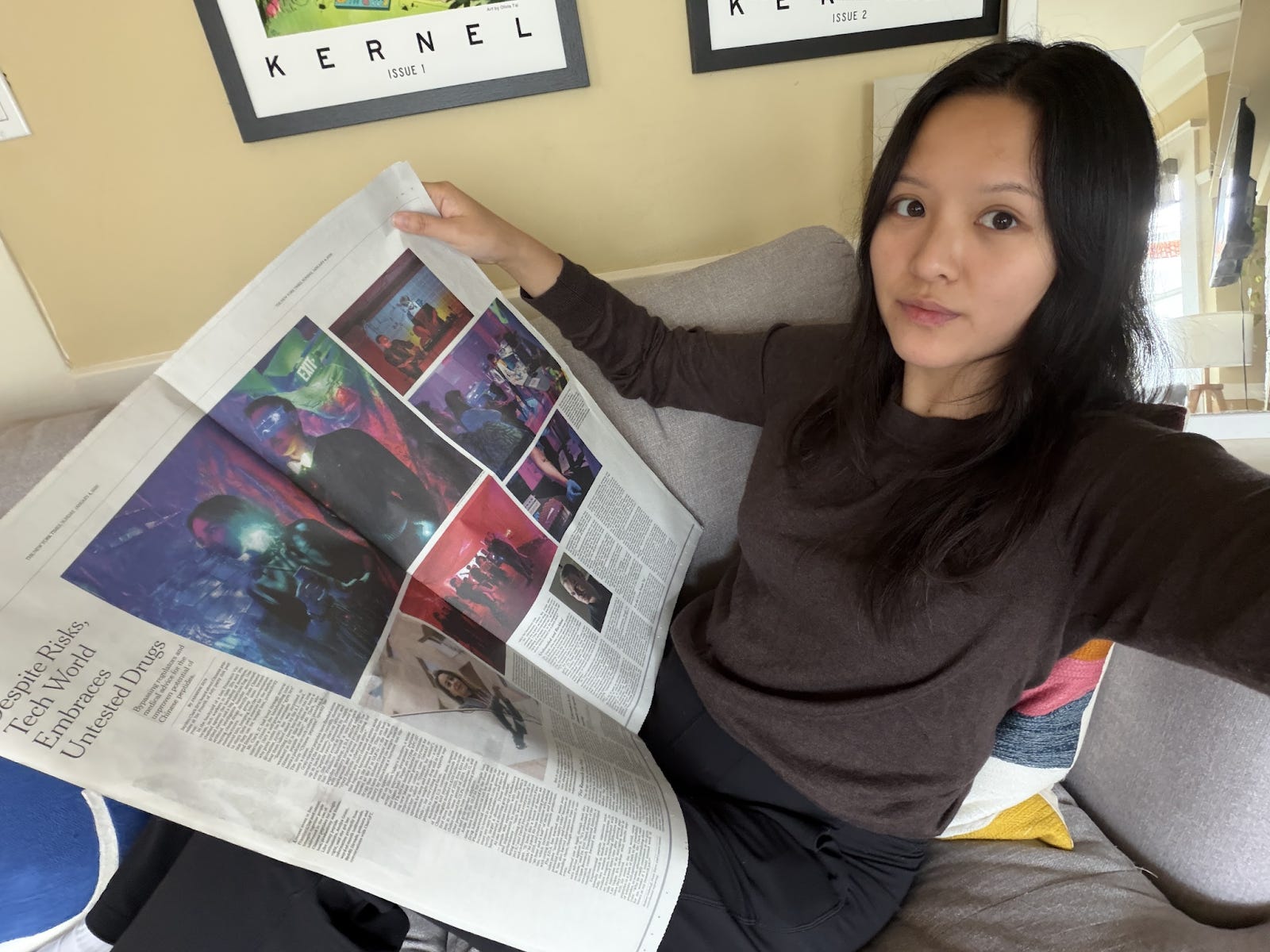
For example, I reported a story for the New York Times about the “Chinese peptide” trend. Step one was the close noticing: realizing it wasn’t just a meme, and rather something people were actually doing. And then the impulse is to think it’s insane: Why are people buying gray market drugs from Chinese factories and injecting themselves? But when I started interviewing users, I began to see peptides as part of a specific ‘frontier ethic.’ These people trust themselves and their community’s knowledge more than they trust the FDA. Those I spoke to knew the health risks—they weren’t uninformed—but prided themselves on trying peptides anyway, because they see themselves as the sort of person who likes high-variance bets. I also grew to see the value in gray markets: we don’t want to approve and mass-promote untested drugs, while leaving space for experimentation at the edges. But you only get this understanding if you keep an open mind, actually talk to people, and look for the deeper meaning.
Are there particular historical media writers you admire?
I try to draw influences from a lot of different places, but Susan Sontag is a huge one for me.
She’s mostly known as a culture and art critic, which might seem different from tech writing, but the skills are actually quite similar. Great art criticism is about close observation—being able to pay attention to the precise form of a thing, first describe it, and then contextualize it in a broader cultural or political milieu.
She was very attentive to media and how it shaped culture. One of her most famous books is On Photography. She looked at how photography—one of the most transformative technologies of her time—changed how the public understood the news and empathized with each other.
I also just think she’s a great polemicist; I respect that she was great at writing ‘takes.’ I’ve reread Against Interpretation and Notes on Camp many times.
What advice would you give to someone who wants to start writing full-time?
Quitting your job to write is actually much easier than it looks. Everyone asks me how to do it like it’s this complicated thing, but I literally just went to my manager at Substack after a few years and said, ‘I think I’m going to leave; I really want to be a writer.’
I had absolutely no plan—no job, no freelance gigs, no new money lined up. But I had runway for a year, and figured I could be a PM again if it didn’t work. Fortunately, I didn’t have to. Within three months of quitting, I had more projects than I could keep up with.
I’m a big believer that the internet is a way to increase your surface area for luck. I try to blog about my life transitions—like the New Year, major travel, or changing jobs. I write posts to introduce new research interests I’m pursuing. Writing is a way to track each chapter of my life as it passes by, but more importantly, it signals to the world what my values and ambitions are.
When I wrote about leaving Substack, people I’d never met before reached out with offers to chat, or links to grants to apply to. The same thing happened after we went to China together: because we all wrote up our reflections, I now have 20 people ready to show me around next time. There’s also a proof-of-work element to it: blogging, even before you quit your job, is a way to demonstrate commitment and curiosity and skill. I rarely have to blind-pitch editors, because they’ll see my Substack and reach out.
People want to help you realize your dreams if you are earnest about them. So, my advice is: write very genuinely and very publicly about who you are and what you care about. The more you tell the world what you want, the more likely you are to get it.
People often ask me ‘What is Interact?’ and I never have a good answer. But given that we have an anthropologist of Silicon Valley here, how would you situate and describe Interact within the Silicon Valley culture?
I describe the Interact new fellow retreat as ‘summer camp for nerds.’
Essentially, you have these cracked 22-year-olds who excel in their field. They are super ambitious and have taken these odd, winding paths—maybe they’re college dropouts, or the kind of person who skips class to hack all day, or have been digital nomading for the last 5 years. But because they start working at 16, with VCs constantly telling them they’re amazing and trying to throw millions of dollars at them, they don’t really get to have a normal childhood. They’re always the youngest person in the room; they don’t have many peers. They probably never log off, and don’t know who they are outside of work.
The point of Interact is to provide a non-instrumental space for ambitious young people. It’s about escaping the rat race and venture capital and social media clout, and connecting with each other on a deeply human level—whether that’s playing in a stream, book clubbing philosophy, or talking about love lives late at night.
Do you have an Interact story to share with us?
Well, there’s the time I crashed with you and Kelvin Yu (Interact ‘22) in DC when I was trying to meet some AI policy people. I assumed we were friends, but you were like, who’s this weirdo, we barely know each other! You only took me in out of sheer kindness and hospitality, plus the trust built into the Interact community.
So that’s another definition for Interact: a couchsurfing network all over the world.
If any part of Jasmine’s experience or ideas resonated with you, you should apply for Interact 2026 Fellowship!
 | A guest post by
|
Brillaint piece on the anthropological lens. The peptide story example really nails how easy it is to judge from the outside versus understanding the internal logic of a community. I remember talkign to some biohackers last year and initially thinking it was reckless, but they operated with a totally diffrent risk calculus than I did. Thick description matters more than people realize when covering subcultures.
<>Why are people buying gray market drugs from Chinese factories and injecting themselves?>>
In most cases, it’s because insurance won’t cover the medications they need. If they could get an FDA-approved medication they could afford, that’s what they’d use. This isn’t their first or second choice; it’s their only choice.